Speculative trading means taking financial positions primarily to profit from expected changes in market prices. The trader may buy because they expect an asset to rise, sell short because they expect it to fall, or use derivatives to express a view on direction, volatility or another market variable. Holding periods can range from seconds to several months, which is why speculative trading includes very different activities under one broad heading.
A scalper holding EUR/USD for two minutes, a day trader buying shares after an earnings announcement and a swing trader holding an index position for two weeks are all speculating on future price movement. Their timeframes, trading costs and risk controls differ substantially, but each is relying on an expectation that the market will move favourably after the position is opened.
Speculation is therefore not a single strategy, and it should not automatically be equated with gambling. A systematic trader can define entries, exits, position size and maximum losses before placing a trade. At the other end of the spectrum, somebody can buy an asset simply because it has risen quickly and hope the movement continues. Both activities may technically be speculative, but the quality of the process is rather different.
The important distinction is between the timeframe of a trade and the reason for entering it. Day trading, swing trading and scalping mainly describe how long positions are held. Trend trading, momentum, mean reversion, breakout and news trading describe what the trader believes prices are likely to do. These categories frequently overlap, which explains why two traders can describe the same position in several different ways.
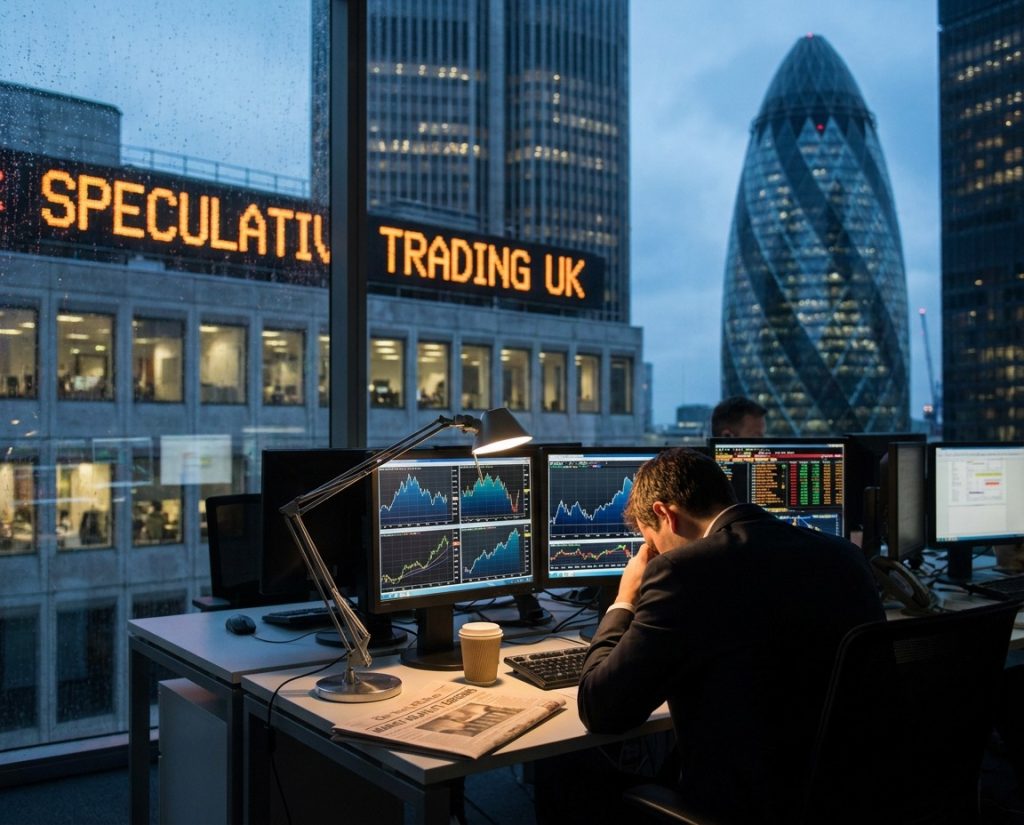
Speculative Trading vs Investing
Investing and speculative trading can involve exactly the same financial asset while relying on different reasoning. An investor might buy shares in a profitable company because they expect earnings, dividends and the value of the business to increase over the next decade. A speculative trader might buy the same shares because price has broken above a three month resistance level and appears likely to continue higher during the next several sessions.
The investor’s return depends heavily on what the underlying asset produces over time. The trader is more interested in what other market participants will pay for it over a shorter period. This does not mean investors ignore price or traders ignore fundamentals. The distinction concerns which factor is doing most of the work in the decision.
Time also changes how losses are interpreted. A long term investor may reasonably continue owning a broad equity fund after a 15% market decline if the original objective remains twenty years away. A day trader who bought a stock for an intraday breakout does not have the same justification for holding it six months later after the breakout failed.
One of the more expensive habits in trading is entering with a speculative thesis and converting the position into an “investment” only after it becomes unprofitable. The trader has changed the rules after discovering the first set of rules produced an uncomfortable result.
Long term investing can also contain speculation. Buying a company at an extreme valuation because somebody expects another investor to pay considerably more five years from now involves a speculative assumption even if the holding period is long. Likewise, a short term arbitrage or hedging transaction can involve relatively little directional speculation despite lasting only a few hours.
The useful distinction is therefore not that investing is responsible and speculation is reckless. It is that speculative trading deliberately tries to extract returns from shorter term changes in price, behaviour or market conditions. Because those movements are uncertain and trading costs are incurred more frequently, the process needs tighter risk control.
Day Trading
Day trading involves opening and closing positions within the same trading day. The trader normally finishes the session without the market exposure created by those positions, reducing the risk that overnight news causes a large gap before an exit can be made. In exchange, the entire trading opportunity has to develop within a much shorter period.
A day trader might buy a stock after it breaks through an important intraday level, sell an index future during a momentum move or trade currencies around a scheduled economic announcement. The holding period may last several hours or only a few minutes. What defines the style is that the position is generally closed before the relevant trading session ends.
The shorter timeframe makes execution unusually important. A strategy targeting a 0.4% movement cannot absorb trading friction as easily as an investor expecting a 50% gain over several years. Bid and ask spreads, commissions and slippage can remove a meaningful part of the gross return before the trader has made any strategic mistake.
The SEC’s day trading risk guidance describes day trading as highly risky and warns that leverage can increase losses as quickly as it increases gains. The warning is old enough to have survived several generations of trading platforms for a reason: faster software has not removed the arithmetic of risk.
A broad starting point for the mechanics, markets and strategies involved can be found at DayTrading.com. Its current trading strategy material covers approaches including trend following, momentum, mean reversion, scalping and news trading, which illustrates why day trading is better viewed as a timeframe than one fixed system.
Day Trading Does Not Require Constant Trading
The name creates a minor behavioural trap. A day trader does not need to place trades every day, and a trading session without a suitable setup does not represent lost productivity. A strategy that works under high volatility may have little reason to operate when markets are unusually quiet, while another may perform poorly immediately after major news.
Trying to meet a daily profit target can make this worse. The market does not know that a trader wants to earn £200 before lunch. Once a trader begins placing marginal positions simply because the daily target has not been reached, the objective has started dictating the trades rather than the other way around.
The same problem appears after losses. A trader down £300 can become focused on returning to zero rather than waiting for the next valid setup. Revenge trading is simply position selection being influenced by a previous result that has no effect on the probability of the next trade.
A structured day trader therefore needs rules for when not to trade as much as rules for entry.
Day Trading Rules Depend on the Market
Trading regulations vary by product and jurisdiction. US equity day traders have historically encountered the Pattern Day Trader framework, including the familiar $25,000 minimum equity requirement in qualifying margin accounts. FINRA adopted replacement intraday margin standards effective June 4, 2026, but brokerage firms have a transition period running through October 20, 2027, so customers can encounter either framework during that period depending on their broker.
That rule does not apply universally to every form of day trading. Futures, forex, CFDs and securities accounts in other countries operate under their own regulatory and margin structures. A trader should therefore understand the legal product before assuming a rule encountered in a US stock trading discussion applies to another market.
The principle is broader than one regulation. A viable strategy has to fit both the market and the account through which it is traded.
Scalping
Scalping compresses speculative trading into very short holding periods, sometimes seconds or a few minutes. Rather than trying to capture a large market move, the trader aims to take small portions of movement repeatedly. A forex scalper might pursue several pips, while a futures trader may aim for a small number of ticks.
The attraction is that market exposure is brief. The trader is not normally waiting several weeks for a thesis to work and often finishes each session without open positions. The cost is that everything becomes more sensitive to execution. A few tenths of a pip, one tick of slippage or an extra commission can determine whether a marginal strategy has positive expectancy.
Suppose a scalping strategy makes an average gross profit of £8 per trade before costs. If the combined spread, commission and average slippage amount to £6, the actual edge is only £2. A small deterioration in execution could remove it entirely even though the trading signals continue behaving exactly as expected.
This is why historical testing for scalping needs realistic bid and ask prices rather than perfect fills at chart midpoints. A backtest can look impressive simply because it assumes executions that would never have been available in live markets.
Scalping also produces a high number of decisions. A trader placing twenty positions in a morning has twenty opportunities to ignore a stop, chase an entry or increase position size after a loss. Fast trading therefore does not reduce the importance of discipline. It increases the frequency with which discipline is tested.
High win rates can also disguise poor economics. A scalper might win eight trades out of ten but lose money if the two losing positions are several times larger than the winners. Win rate is therefore only useful when considered alongside average gain, average loss and trading costs.
Swing Trading
Swing trading operates at a slower pace. Positions generally remain open for several days or weeks while the trader attempts to capture a meaningful part of a market move. The style sits between conventional day trading and longer term position trading, making it practical for people who cannot monitor markets continuously.
A swing trader might buy a stock after it breaks from a multiweek consolidation, trade a pullback within a broader trend or hold a currency position while monetary policy expectations move gradually in one direction. Because the expected move is larger, tiny differences in commissions usually matter less than they do for scalpers.
The trade off is overnight risk. A company can release unexpected information after the market closes, a geopolitical event can occur during a weekend and currencies can open at different levels after periods of reduced liquidity. A stop order can help control ordinary losses but cannot guarantee execution at the intended price if the market gaps past it.
For a broader treatment of the style, SwingTrading.com focuses specifically on swing strategies, technical analysis, market selection and risk management. Its current strategy material describes swing trading as an attempt to capture short and medium term price movements while accepting overnight positions.
Swing Trading Changes the Decision Cycle
The slower timeframe gives traders more time to analyse entries, but that does not automatically improve decision quality. A swing trader can simply spend longer interfering with the same position. A trade entered on Monday may fluctuate between profit and loss for several days before reaching either the intended target or stop.
This produces a different psychological problem from scalping. Instead of making too many rapid decisions, the trader may make unnecessary adjustments because there is too much time to think. A minor intraday decline appears important even though the setup was based on a daily chart, or a profitable trade is closed early because unrealised gains temporarily fall.
Monitoring frequency should therefore match the strategy. A trade designed around daily price structure should not automatically be managed according to every five minute movement. The trader still needs to respond when the setup is genuinely invalidated, but normal noise should not be allowed to rewrite a plan designed for a longer horizon.
Swing trading is slower. It is not passive.
Trend Trading
Trend trading attempts to profit from directional persistence. Instead of predicting that a market has moved too far and should reverse, the trader assumes that an established movement may continue for longer than other participants expect.
The method can operate on almost any timeframe. A scalper can trade a five minute trend, a swing trader can follow a movement lasting several weeks and a position trader can hold a broader macro trend for months. This is why trend trading describes the logic of the position rather than how long it remains open.
A simple trend system might define an uptrend through higher highs, higher lows and price remaining above a moving average. Positions are then taken primarily in the direction of that movement. More systematic approaches can use breakouts, volatility measures or statistical rules to identify direction.
The main weakness is false starts. Markets often begin moving and then reverse before a meaningful trend develops. A trend trader can therefore experience several small losses while waiting for one larger winner.
This can produce a strategy with a surprisingly low win rate. Six £100 losses and two £400 gains still produce a £200 profit before costs. The trader was wrong 75% of the time but profitable because the winners were much larger than the losers.
That profile is psychologically awkward for people who equate being right with making money. Speculative trading rewards favourable arithmetic, not personal accuracy.
Momentum Trading
Momentum trading is closely related to trend trading but places more emphasis on the strength and persistence of current movement. The trader seeks assets where buying or selling pressure is already unusually strong and expects that activity to continue long enough to create another tradable move.
A stock rising sharply after better than expected earnings is a common example. New information causes investors to reassess the company, short sellers may cover positions and traders watching the move can add additional demand. Momentum persists because the entire market does not update its expectations simultaneously.
The danger is entering after the opportunity has already become obvious. A stock can be genuinely strong while still offering a poor entry after a rapid move. Chasing at an extended price can force the trader either to accept a very wide stop or place a narrow stop inside normal volatility.
Momentum traders therefore need some method for deciding when strength remains tradable and when price has become too extended. Some buy immediate breakouts. Others wait for a short consolidation or pullback before entering.
The strategy also needs an exit when momentum disappears. Holding indefinitely because a stock used to be strong converts a momentum trade into another type of position without necessarily improving the expected result.
News Trading
News trading tries to profit from market repricing after new information arrives. Earnings announcements, central bank decisions, inflation reports, employment data, takeover offers and unexpected political events can all produce sharp movements when the information differs from what investors had expected.
The final phrase matters. Markets generally react to the difference between new information and existing expectations rather than whether a headline sounds positive or negative in isolation. A company can announce record profits and see its shares fall because investors expected even stronger numbers. Inflation can remain high while a currency weakens because the figure came in below consensus.
This makes news trading more difficult than simply reading headlines quickly. Institutional firms invest heavily in low latency data and automated systems capable of interpreting scheduled releases within fractions of a second. A retail trader using an ordinary web browser is unlikely to beat those systems consistently to the first reaction.
Retail news trading can instead focus on what happens after that initial repricing. Markets sometimes establish a directional move that lasts hours or days once participants have had time to assess the implications.
Execution risk is unusually high during major releases. Spreads can widen, liquidity can disappear and stop orders can fill much worse than their trigger levels. A strategy that normally risks £100 using a tight stop can therefore lose more than expected when the next available price is substantially worse.
Event Driven Trading
Event driven trading is broader than reacting to breaking news. A trader can build a position before or after an identifiable event expected to change market valuation. Company earnings, regulatory decisions, index rebalancing, mergers and central bank meetings all fall into this category.
Trading before an event involves accepting binary-like uncertainty. The trader knows something is about to happen but does not know the result or how the market will interpret it. Trading after the event removes some information uncertainty but can mean entering after a large portion of the move has already occurred.
Both approaches can work under the right conditions, but they involve different risk profiles. A trader holding through earnings can experience a substantial overnight gap that bypasses any ordinary stop. Someone waiting until after the announcement reduces that gap exposure but may receive a less attractive entry.
Event traders therefore need to distinguish between risk they can measure under normal market conditions and discontinuous risk created by price gaps. Position sizes suitable for an ordinary technical setup may be excessive when the next tradable price could be several percentage points away.
The event itself should also have a plausible reason to change supply, demand or expectations. Trading every scheduled announcement simply because a calendar marks it in red produces activity, not necessarily an edge.
Breakout Trading
Breakout trading attempts to profit when price moves beyond a level that previously contained it. A stock might trade between $40 and $45 for several weeks before finally moving above $45. The breakout trader interprets the move as possible evidence that the balance between buyers and sellers has changed.
This method can be used intraday or across several weeks. Day traders may focus on breaks of the morning high, while swing traders can look for price leaving longer consolidations. The underlying principle is the same: an established price boundary has failed and movement may continue.
False breakouts are the main problem. Price can move briefly beyond an obvious level, attract new traders and then return to the previous range. A trader buying immediately can become trapped almost as soon as the position is opened.
Some breakout methods require a closing price beyond the level. Others look for unusually high volume or wait for price to return and test the previous boundary. None eliminates false signals.
The strategy therefore depends on controlling the loss when continuation fails rather than finding a confirmation signal that guarantees success.
Mean Reversion Trading
Mean reversion starts from almost the opposite assumption. Instead of expecting movement to continue, the trader believes an unusually stretched price is likely to return closer to a normal level.
The reference point can be a moving average, volume weighted average price, statistical band or another estimate of where the market usually trades. A short term trader might buy after an index falls unusually far below its intraday average, expecting some of the movement to reverse. A swing trader can apply the same idea to a move that developed over several days.
The strategy often performs best when markets are range bound. Its largest danger appears when an apparent temporary deviation is actually the beginning of a major trend. A stock does not need to return to yesterday’s average after unexpected information fundamentally changes its value.
Mean reversion strategies can also create attractive win rates because many small deviations do reverse. That success can encourage traders to keep adding when one position fails to recover.
Averaging down without a predefined maximum position can turn a controlled speculative trade into an increasingly large bet that the market must eventually come back. Markets are under no obligation to cooperate.
Contrarian Trading
Contrarian trading takes positions against prevailing market sentiment when the trader believes expectations have become excessively optimistic or pessimistic. It overlaps with mean reversion but can also involve fundamental analysis, positioning data and valuation.
The method sounds intellectually appealing because the trader is refusing to follow the crowd. Unfortunately, disagreeing with everyone else is not automatically evidence that everyone else is wrong.
A rapidly rising market can remain expensive for much longer than expected, while panic selling can continue after an asset already appears historically cheap. A contrarian trader therefore needs evidence beyond discomfort with the current price.
This can include weakening momentum, extreme positioning, changes in liquidity or a catalyst that may force the market to reassess existing expectations. The position still requires an invalidation point.
Without one, contrarian trading can become an elaborate explanation for holding losses. Every additional movement against the trader appears to confirm that the crowd has become even more irrational.
Being early and being wrong can produce the same account statement if risk is uncontrolled.
Speculative Trading Across Different Markets
The same trading idea behaves differently depending on the instrument used. Shares have company-specific information, exchange trading hours and individual liquidity. Forex trades relative currency values and is heavily influenced by monetary policy, interest rate expectations and macroeconomic data. Futures provide standardised leveraged exposure to indices, commodities and other markets, while options add the effects of time and implied volatility.
A momentum strategy that works well in liquid equities may behave very differently in an exotic currency pair with wider spreads. A swing trading system built on shares may need different risk assumptions if transferred to futures, where contract sizes and leverage can make each tick financially larger.
CFDs and spread bets introduce another layer because the broker is generally providing a derivative rather than the trader buying the underlying asset directly. UK retail CFD rules, as one example, limit leverage between 30:1 and 2:1 depending on the asset and require margin close out and negative balance protections. The FCA explains those rules in its retail CFD framework.
A speculative strategy therefore cannot be assessed separately from the instrument used to implement it. Market structure affects costs, leverage, execution and the type of loss that can occur.
Leverage in Speculative Trading
Leverage increases market exposure relative to the trader’s own capital. It can make a small underlying movement financially meaningful, which is why it appears so frequently in forex, futures, CFDs and margin stock trading.
The arithmetic works in both directions. If £5,000 of capital supports £50,000 of market exposure, a 2% favourable movement represents roughly £1,000 before costs. The same 2% movement in the wrong direction also represents £1,000, equal to 20% of the capital initially committed.
Leverage does not improve the quality of the trading signal. If a strategy loses money before leverage, increasing position size simply makes the same negative expectancy more expensive.
Margin also introduces broker-specific risks. Investor.gov explains that a brokerage can require additional funds when account equity falls and may sell securities to cover a shortfall, sometimes without consulting the customer first. Its margin account guidance also notes that firms can impose requirements stricter than regulatory minimums.
For speculative traders, leverage should therefore follow position sizing rather than determine it. Decide the amount that can be lost if the setup fails, establish where the trade becomes invalid and calculate position size from that distance. Maximum buying power is a broker limit, not a trading instruction.
Transaction Costs Matter More as Trading Frequency Rises
Every trade begins with some degree of friction. There may be a bid and ask spread, commission, exchange charge, overnight financing or slippage between the expected and actual execution price.
For a long term investor making a handful of transactions each year, modest dealing costs can be relatively unimportant. A scalper placing hundreds of trades per month experiences the same charges repeatedly, which makes cost control part of the strategy rather than an administrative detail.
Consider a method that generates an average theoretical profit of £12 per trade before costs. If the combined spread, commission and slippage average £9, the edge is only £3. The strategy can be profitable in a spreadsheet while being extremely vulnerable to slightly worse execution in live trading.
This also explains why a broker that is suitable for swing trading may not be appropriate for scalping. A swing trader targeting several percentage points can tolerate a slightly wider spread if other conditions are good. A short term trader targeting fractions of a percent cannot.
Overnight financing creates the reverse problem. A day trader closing before the financing cutoff may barely notice it, while a leveraged swing position held for three weeks can accumulate meaningful carrying costs.
Total cost should therefore be evaluated according to how the strategy actually trades.
Position Sizing
Position sizing determines how much money is exposed when a trade fails. This is more important than whether the method is called trend following, news trading or scalping because every speculative style eventually encounters losing positions.
Suppose a trader is prepared to lose £100 on a setup. A stock is purchased at £20 with an invalidation point at £19.50, giving 50p of planned risk per share. Roughly 200 shares correspond to £100 of market risk before slippage and dealing costs.
If another trade requires a £2 stop, the same £100 risk limit allows only 50 shares. The wider stop naturally produces the smaller position.
This process prevents volatile markets from receiving the same nominal position as stable ones. Buying 1,000 shares every time may feel consistent, but it creates wildly different financial risks when one stock moves 1% per day and another moves 8%.
The same logic applies to currency units, futures contracts and other leveraged instruments. Contract mathematics differ, but the underlying question is unchanged: how much can this position remove from the account if the trade is wrong?
Risk to Reward and Expectancy
Risk to reward ratios are useful only when considered alongside probability.
A trade risking £100 to potentially make £300 has an apparent reward to risk ratio of three to one. That sounds attractive, but the target can be placed anywhere on a chart. If the £300 target is reached only 10% of the time, the strategy can still lose money.
Expectancy combines average gains, average losses and their respective probabilities. A method winning 40% of trades can be profitable if the average winner is much larger than the average loser. A method winning 80% can lose money if the occasional losing trade is allowed to become enormous.
This is why high win rates should be treated carefully in trading promotions. They say very little without information about the distribution of outcomes.
Trend trading often accepts relatively low win rates in exchange for larger winners. Some mean reversion strategies produce the opposite profile, earning many small gains while occasionally suffering a large loss when the market refuses to revert.
The relevant question is not how often the trader feels correct. It is what happens financially after the wins, losses and costs are combined.
Stops Do Not Guarantee the Planned Loss
Stop orders help define risk but cannot guarantee the exact exit price under every market condition.
If a stock closes at £20 and a stop sits at £19, unexpected news can cause the next available market price to be £17. The order may execute near £17 because there were no buyers willing to transact around £19 when trading resumed.
This gap risk matters especially to swing and event traders who hold positions through periods when markets are closed or liquidity is thin. Day traders face less overnight gap exposure but can still experience poor execution during sudden intraday moves.
News traders encounter another version of the same problem. A scheduled economic release can cause spreads to widen and prices to move through several levels before a market order is filled.
Position size therefore needs to reflect not only the intended stop distance but also the possibility that the realised loss can exceed it. The more discontinuous the market can become, the less sensible it is to size a position as though execution will always be perfect.
A stop is a risk control. It is not an insurance contract.
Trading Psychology and Speculation
Speculative trading produces rapid feedback, and rapid feedback can distort decisions.
After a profitable sequence, the trader may conclude that skill has improved and increase position size precisely when confidence is least objective. After several losses, the desire to recover money can create revenge trading, where the next position is selected partly because it might erase the previous result.
Neither reaction changes the probability of the setup.
Boredom can be equally expensive. A trader who has spent three hours watching a market without finding an opportunity can begin lowering entry standards simply to make the session feel productive. The position then exists because the trader wants action rather than because the strategy identified an advantage.
A defined trading process reduces the number of decisions that need to be improvised while money is at risk. Entry criteria, maximum position size, invalidation points and conditions for stopping trading can all be considered before emotional pressure appears.
Psychology is sometimes treated as though successful trading requires eliminating emotion. A more practical objective is to prevent ordinary emotion from changing position size and strategy rules.
Building a Speculative Trading Process
A useful trading process starts narrow. Choose a market, timeframe and setup clearly enough that similar trades can be compared with one another. A trader taking one breakout, one earnings gamble, two mean reversion trades and an impulsive cryptocurrency position has not produced five observations of a strategy. They have produced five unrelated outcomes.
The setup should define what needs to happen before entry, where it becomes invalid and how the position will be managed if it moves favourably. Position size can then be calculated from the intended loss rather than from available leverage.
Historical testing can provide an initial indication of whether the idea has merit, although realistic costs and execution assumptions matter. Paper trading can then test whether the method is operationally practical without risking capital.
Simulation has obvious limits. Losing £1,000 in a demo account does not feel like losing £1,000 of actual savings, and simulated orders may receive fills that live markets would not provide.
Small live positions therefore provide information that backtests and demo accounts cannot. The objective at that stage is not generating a salary. It is testing whether the process still works when execution is real and losses have consequences.
Keeping a Trading Journal
A trading journal is useful because memory is remarkably good at preserving spectacular winners and surprisingly bad at recording ordinary mistakes.
For each position, the trader needs enough information to identify the setup, planned risk and actual outcome. More important than the raw profit or loss is whether the trade followed the strategy. A perfectly executed trade can lose because uncertainty is unavoidable. A profitable trade can still be poor if it violated every risk rule and happened to work.
After enough comparable trades, the journal can reveal where expectancy actually comes from. Breakouts may perform better after earnings, trend trades may struggle in low volatility markets or news positions may consistently suffer excessive slippage.
Without records, traders often respond to short losing periods by changing strategy. Sometimes the strategy is the problem. At other times the method is fine and the trader has simply stopped following it.
Those are very different problems and need different fixes.
Speculation Does Not Require Predicting Everything
A profitable speculative strategy does not need to forecast every market movement. It needs a repeatable situation where the relationship between probability, average gain, average loss and cost remains favourable.
A trend trader can lose on several false breakouts before one large movement pays for them. A mean reversion trader can accept that some stretched markets never return to their previous average. A news trader does not need to predict every headline if there is a measurable way to trade how markets respond after certain events.
The edge can also be small. In competitive financial markets, strategies that produce large reliable returns with little risk tend to attract capital quickly. Retail traders should therefore be skeptical of anyone presenting speculative trading as a sequence of obvious high probability opportunities.
The practical task is less dramatic. Find conditions that appear to offer a modest statistical advantage, control what happens when those conditions fail and avoid trading costs consuming the result.
That approach is not as exciting as promising 90% win rates. It has the advantage of resembling how risk actually behaves.
Choosing Between Day Trading, Scalping, Swing Trading and Trend Trading
There is no objectively best speculative style because different methods place pressure on different parts of the trading process.
Scalping requires concentration, efficient execution and tolerance for many rapid decisions. Day trading removes most overnight exposure but still requires substantial screen time and makes transaction costs important. Swing trading provides more time for analysis and can fit around another occupation, but the trader accepts overnight and weekend gaps.
Trend trading can operate across any of those timeframes. It often requires accepting repeated small losses while waiting for larger directional moves. Mean reversion can provide more frequent winners but can suffer heavily when what looked temporary becomes a genuine trend. News trading offers large movement but introduces unusual execution and information risk.
The practical fit matters. Somebody who can review markets only once each evening is unlikely to execute a thirty second scalping strategy well. A trader who cannot tolerate seeing an unrealised position fluctuate overnight may dislike swing trading regardless of its historical results.
Capital matters too. Some strategies require broader stops or particular contract sizes, while others create high transaction frequency that makes small accounts inefficient.
The correct style is therefore one that can be tested, financed and followed consistently rather than whichever approach currently receives the most attention online.
Speculative Trading as a Discipline
Speculative trading covers a large group of activities, from seconds-long scalps to multiweek swing trades. Day trading, scalping and swing trading mainly define how long the trader remains exposed. Trend, momentum, breakout, mean reversion and news trading describe different beliefs about what prices are likely to do during that exposure.
Those labels are useful for organising strategies, but they do not determine profitability. A poorly controlled trend strategy can lose money just as quickly as an impulsive day trade, while a short term method can be systematic and carefully risk managed.
The dividing line is process. A structured speculative trader knows why a position is being opened, where the idea becomes invalid, how much capital is at risk and whether previous trades using the same method produced evidence of an advantage. Trading costs and leverage are included before judging results rather than treated as minor details afterwards.
Speculation always involves uncertainty. No indicator, timeframe or trading style removes it. The purpose of a trading method is not to make every prediction correct. It is to keep incorrect predictions small enough that the profitable ones still have something left to work with.